


Window compliance shouldn’t hurt
As an industry, we’re seeing an increase in imported window and door systems coming to our shores and, while imported products are not the problem, non-compliant ones are. Last year’s introduction of the overseas building products legislation brought about change to our industry. Throughout the process we were supportive of it, believing it would bring structure where none previously existed to the products already being imported into New Zealand. A government under pressure to reduce the cost of building believed making imported product more accessible would achieve these goals. The legislation coincided with a rise in imported windows, doors, glass, and components. To be clear, we take no issue with imports, provided they’re priced appropriately and, most importantly, are able to demonstrate compliance with our Code and regulations. The issues arise when evidence is thin, claims are misunderstood, or the product’s tested scope doesn’t match the project conditions.
Price pressure
We recently investigated a company providing windows to a project in Auckland at a price lower than the component cost of the locally produced, specified product. A bit of competition is a healthy thing. Our colleagues in Australia have been dealing with similar pricing behaviour for several years, and their experience offers some insight as to what may lie ahead. They’ve now reached the point of initiating an anti-dumping action to try and restore something closer to a level playing field. It’s a reminder that ultra-low pricing is often short-term and highly targeted, and can be a strategy aimed at displacing established suppliers. The long-term impact of this kind of price competition is well documented: once-vibrant industries like our own lose competitive capacity, prices eventually rise, supply chains become more vulnerable, and the broader sector absorbs increased costs with few alternatives available. For New Zealand’s window and glass industry — which supports more than 10,000 jobs nationwide — consistent pressure from below-cost imports poses a serious and lasting threat to industry viability, product quality, and the resilience of local supply.
Compliance
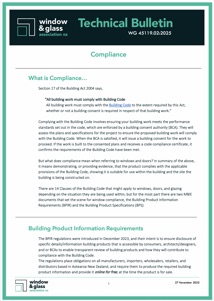
There are many facets to the gem that is building compliance, and windows and glass must respond to some 13 Building Code clauses, not counting Clause C — fire. With windows, doors and glazing there are two primary considerations — product compliance and project compliance.
Product compliance
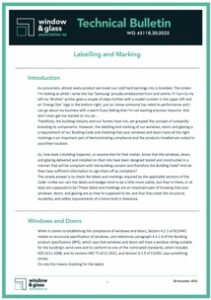
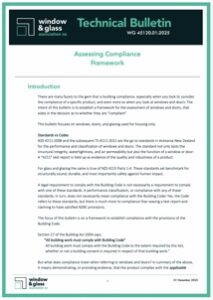
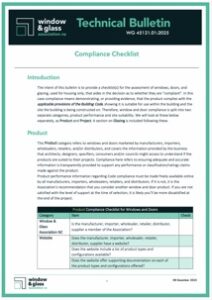
Has the product been legitimately tested and documented? Since 2023, MBIE, through its Building Product Information Requirements (BPIR) scheme, has required that all building product suppliers must provide to consumers specific details on their products. This information must be publicly available online and must include any scope or limitations that apply to the use of the product, and how it contributes to compliance with the NZ Building Code. In terms of windows and doors, this usually means compliance with NZS/TS 4211, but MBIE’s Building Product Specification (BPS) also allows compliance with AS 2047, and is expected to recognise other international window test standards in the future. So, all windows and doors sold in New Zealand must have a classification based on testing, and the simplest way to identify this is to look for the label attached to the window or door frames.

If your windows do not have a label like the above, it is important that the test reports for each of the units is made available for review.
Project compliance
Even a tested and certified window complete with performance label can be non-compliant if the site conditions and/or configuration exceed the tested classification. One of my favourite stories is about a house lot of joinery I was asked to assess — a beautifully made set of timber windows and doors, imported from Europe, complete with a set of test reports to the local standards. Not understanding how the reports applied, the council asked for an assessment to confirm that the joinery’s performance was appropriate for the Auckland site. The windows were great and had a euro classification higher than required. The structural performance of the sliding doors was also great. However, the water penetration rating for the doors barely met the requirements of a Medium wind zone, which made them non-compliant for the High wind zone classification of the site.
Increasingly we encounter products that have been tested and certified with a CodeMark. With a CodeMark your windows are added to MBIE’s register, and must be accepted by BCAs as meeting the requirements of the Building Code. The issue is that few seem to recognise that CodeMarked products have a prescribed set of limitations and scope of use. We see businesses marketing their products using hero shots like the one below. Although the imagery looks impressive, the issue is that often their CodeMarked sliding doors have only been certified for a Low wind zone. The site in the image below is clearly beyond that, as is almost any other site in the Auckland region.
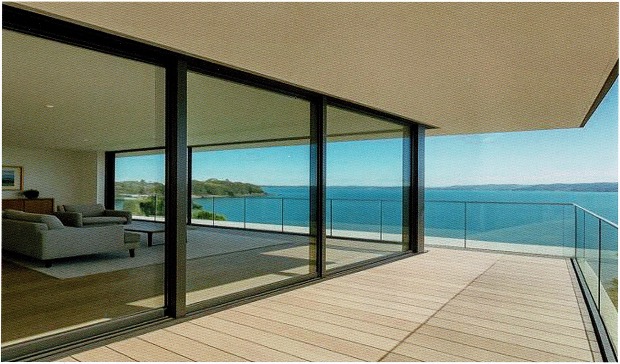
Although the imagery some businesses use looks impressive, the issue is that often their CodeMarked sliding doors have only been certified for a Low wind zone.
What to look out for
In understanding whether or not the windows and doors are compliant and suitable for your project, there are a couple of things to look out for:
- Window labels. Do they have them, and are the classifications appropriate for your site?
- If there are no window labels request the window classification and/or test information.
- Fake or doctored test reports can be hard to spot. Giveaways include:
- incomplete reports – check the page numbers
- pages that vary in size from scanning
- reports with client names that are different to the company you’re dealing with.
- The company website must have a BPIR statement.
- CodeMark — are the windows and doors within the certified scope?
- A quick check of sliding door sill frame heights will give an understanding of expected water performance levels.
- The same applies for mullions also. The taller the mullion the deeper it will need to be to support the increased wind load.
- Use a reputable supplier.
- The basics are, if in doubt, ask the question.
Summary
We recognise that tight budgets are a reality and that competition is healthy, but ask that when looking at the pricing you ensure products are like-for-like, tested, and within scope. A product that looks cheaper at tender can cost more if it triggers consent queries, rework, delays, or early failure.
Whether considering imported or locally sourced windows and doors, if you’re unsure, or the information is unclear, ask the supplier to clarify. If something doesn’t add up, ask the question before installation. Request the reports, check the label, confirm the scope, and ensure the classification aligns to the wind zone for your site, your exposure conditions, and your sizes. You’re not being difficult — you’re protecting the programme, your client, and yourself.